What’s the best stain for Auer rods?

Q. What stain is used for demonstrating Auer rods in myeloblasts? Myeloperoxidase or PAS? (more…)

Q. What stain is used for demonstrating Auer rods in myeloblasts? Myeloperoxidase or PAS? (more…)

Q. If the chronic leukemias have lots of mature cells, and the acute leukemias have immature cells, then how come chronic myeloid leukemia has lots of immature cells? Seems like it belongs in the acute leukemia category! (more…)

Q. I was wondering what the difference was between labeling something as a “leukemia” vs labeling it as a “chronic myeloproliferative disorder.” (more…)

Q. I’m currently doing a research report on acute lymphoblastic leukaemia and I was wondering, are cytomorphology and cytochemistry important in the diagnosis of ALL? (more…)

Another quiz – this time on acute leukemia. (more…)

Many hematopoietic malignancies have characteristic cytogenetic changes, such as translocations or inversions. It’s important to know about these because they can be used for diagnosis in tough cases, and they often carry a prognostic significance. (more…)

Just as there are many different types of myeloid cells (neutrophils, red cells, monocytes, eosinophils, basophils), there are many different types of acute myeloid leukemia (AML). Two types of AML are composed almost entirely of cells of the monocytic series: acute monoblastic leukemia and acute monocytic leukemia. In both of these types of AML, at least 80% of the leukemic cells are from the monocytic series (monoblasts, promonocytes, and monocytes). In acute monoblastic leukemia, most of these cells are monoblasts, and in acute monocytic leukemia, most of these cells are promonocytes. Promonocytes have a very characteristic appearance, as shown above. They have nuclei that show a delicate folding pattern, almost like a piece of tissue paper that has been crumpled a bit. If you had a case of acute leukemia and most of the cells looked like this, you would think about acute monocytic leukemia – and you’d get an NSE to prove it.
Some cases of acute leukemia are composed entirely of undifferentiated-appearing blasts. These cases are difficult (or impossible) to diagnose morphologically (under the microscope) – you really need special tests like immunophenotyping in order to make a definitive diagnosis. (more…)

When you’re faced with an acute leukemia composed entirely of blasts, one way to figure out the identity of those blasts is to use cytochemical stains. (more…)

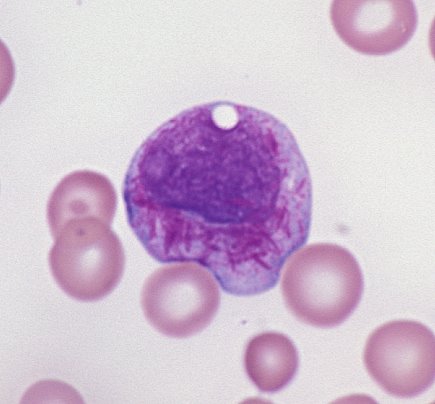
Some types of acute leukemia are composed of only blasts (no differentiating neutrophils, no monocytic precursors, just a sea of blasts). In those cases, look for Auer rods. A blast with an Auer rod can only be a myeloblast! It cannot be a lymphoblast, or a monoblast, or any other kind of blast. So if you see blasts with Auer rods, you know it is some type of acute myeloid leukemia. Remember, though, that the converse is not true: just because you don’t see Auer rods, that does not mean that the blast is not a myeloblast. Some myeloblasts have Auer rods, and some don’t. So if you see Auer rods, it is an AML. If you don’t, it still could be an AML.


Recent Comments